
Michael Lorimer
Michael Lorimer
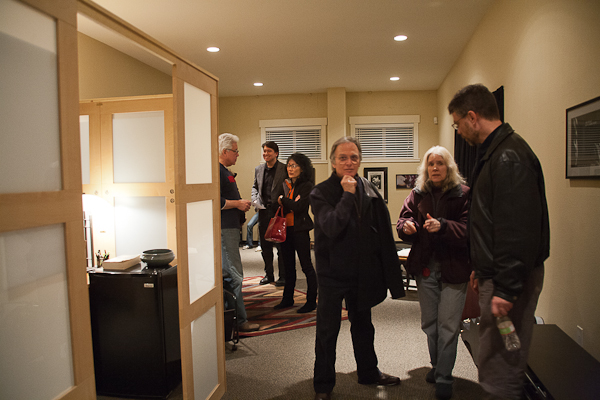
Jeffrey Elliott and Cyndy Burton in the new Kritzer Studio
It was an exciting night – thanks everyone for your participation. It was a nice mix of students, friends, and fans! I welcomed everyone in the main area of the building, and shared some of the upcoming events.
Part of what made this evening special was the performance I was able to share with my first teacher, my brother Jack Kritzer. Beginning a week-long family visit was a nice way to share some exciting studio news and at the same time give my brother the nod he deserves for igniting my interest in the guitar, an interest that grew into an obsession and eventually a career. When I began my classical guitar lessons, Jack joined me, and for a year we’d drive and study together, working on the same technical exercises and assignments. Continue reading
One of the great benefits of Classical Guitar Immersion is the collective knowledge and experience that the participants add to the week-long event. In fact, it’s an integral part of the ‘immersion’ experience. This happens informally, with chats on the way to the dining hall, or at night by the fireside, or in our ’round tables’ where we discuss a particular subject.
One day Tom Page was telling me his thoughts on the effects of adrenaline on performance anxiety – which I found very revealing – so I asked him and Doug Campbell (an MD) to lead a discussion on the subject. Tom explained that his expertise was what he could garner from his wife (she does research on stress and immunity at Johns Hopkins University), and Doug shared that he’d retired from practicing medicine years ago, but that he had a brain iPhone app (funny guys, to boot.)
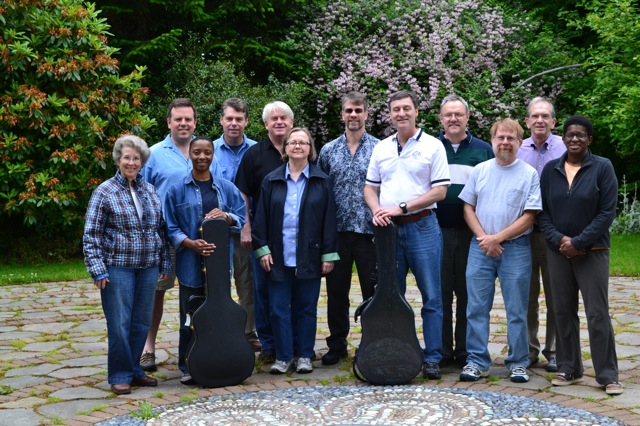
CGI Attendees
In our last installment, we discussed how to get more out of your practice time. Next, we’ll discuss how to get more out of your guitar lessons. While lessons can be expensive, they can also move your playing forward much more quickly than if you study on your own. This post will cover how to get more for your money. Also, I’ll briefly cover supplemental forms of study that the Kritzer Studio provides which will work as a substitute for those who can’t afford private lessons. Continue reading
 Here’s a short interview of me from the Portland show Artclectic PDX with host Dennise M. Kowalczyk.
The following article was submitted by my student Tom Page. It’s a great article and offers some very interesting concepts regarding practice and learning. Great job Tom, thanks!
The chunking theory of learning is based on the concepts that:
• Performance consists of known patterns (chunks) inherent in the task you are performing
• Practice consists of acquiring the necessary patterns (chunks) that you build out of tasks already mastered.
High levels of performance are made possible by the magic of chunking. The time required to process a larger chunk is shorter than the sum of the times to process all the component chunks that comprise it. Hence, acquiring skill consists of building up increasingly larger-scale chunks, such that tasks of increasing complexity can be performed much more rapidly and fluidly than all of the underlying component skills required would imply. Continue reading
Often players, knowingly or not, limit the range of motion when playing the classical guitar. The ‘Minimum Movement’ movement has propagated this idea. The idea being if you can stay close to the string you’ll be able to player faster, that less movement means less exertion. But this couldn’t be further from the truth. A proper range of motion, being bio mechanically correct, allows for a relaxed movement and better tone production.
The following video is an excerpt of a lesson with student Nigel Stadick, working on Prelude from J.S. Bach’s 1st Cello Suite.
I’m quoting here from my Phase I – Free Stroke
Prevalent in my early studies was the concept of ‘minimum motion’. The theory went like this; the more my finger moves the farther it is from the string which slows my response time to get to the next note. A shorter motion keeps the finger poised to play. This may sound good in theory but it’s mechanically unsound. If a finger is stopped from Continue reading
While studying with Michael Lorimer in a special year-long master class off the coast of Wilmington, North Carolina in 1980 I was given the opportunity to play for my teacher’s teacher, Andres Segovia.
Maestro Segovia was to be awarded the Albert Schweitzer award for music, coincidentally, at the University of North Carolina in Wilmington, where our year long master class with Michael Lorimer was held. Having heard that Segovia hated beards I shaved mine off the night before and arrived only assured that I, along with the other students, would get to meet him.
Michael and Jude met with the Maestro first as we all nervously awaited our introductions.
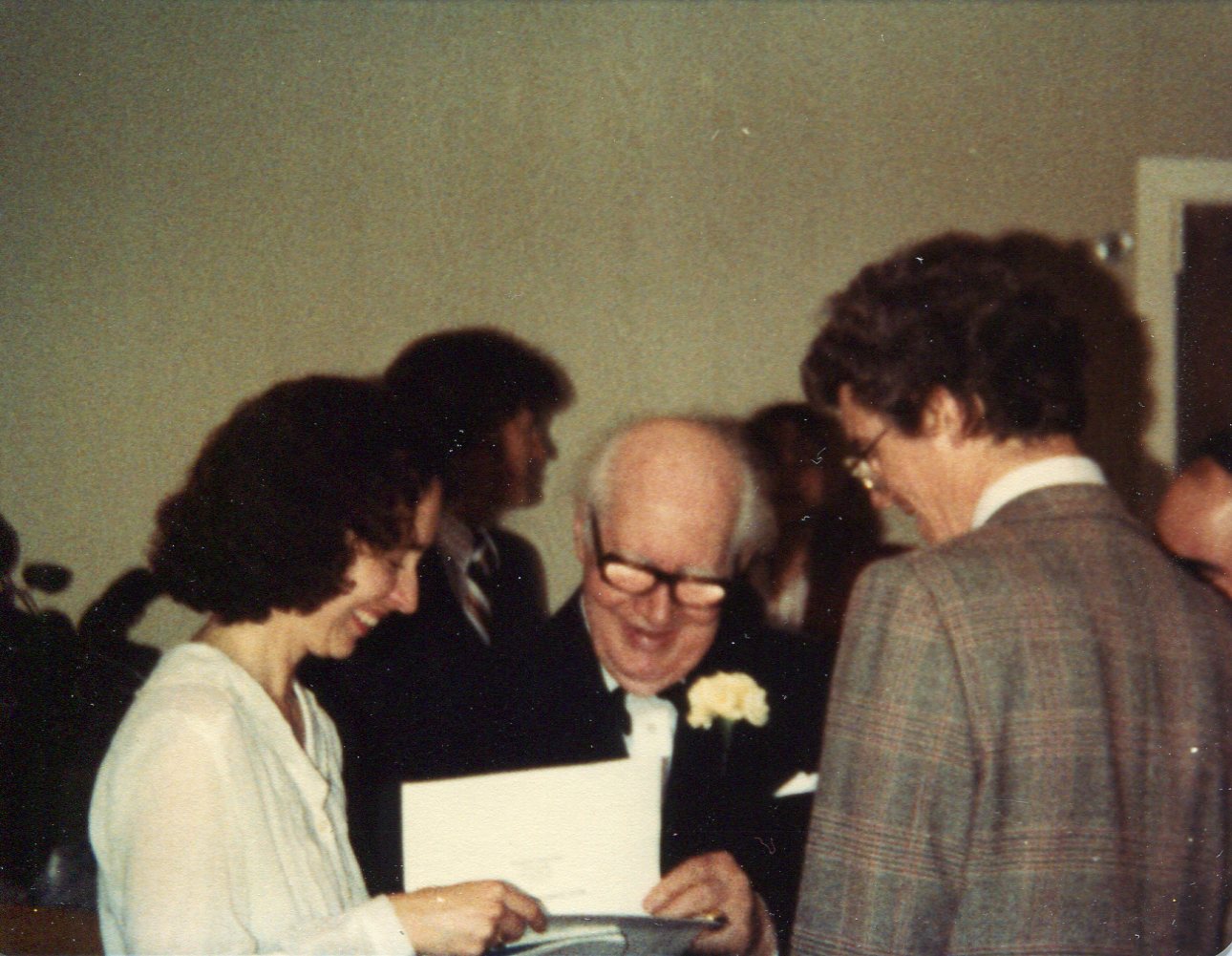
Jude and Michael with Segovia
By Charlie Schultz, student
The name La Folia means “folly” or “madness”. It refers to a dance in 3/4 time that originated in the late 15th century. It was originally a quick paced noisy dance in which the dancers carried men, dressed as women, on their shoulders. There were many different basic themes and there was not one single fundamental melody that dominated the rest for these so called ‘early’ Folia. These Folias became very popular in Spain and Italy.

Composer Jean-Baptiste Lully